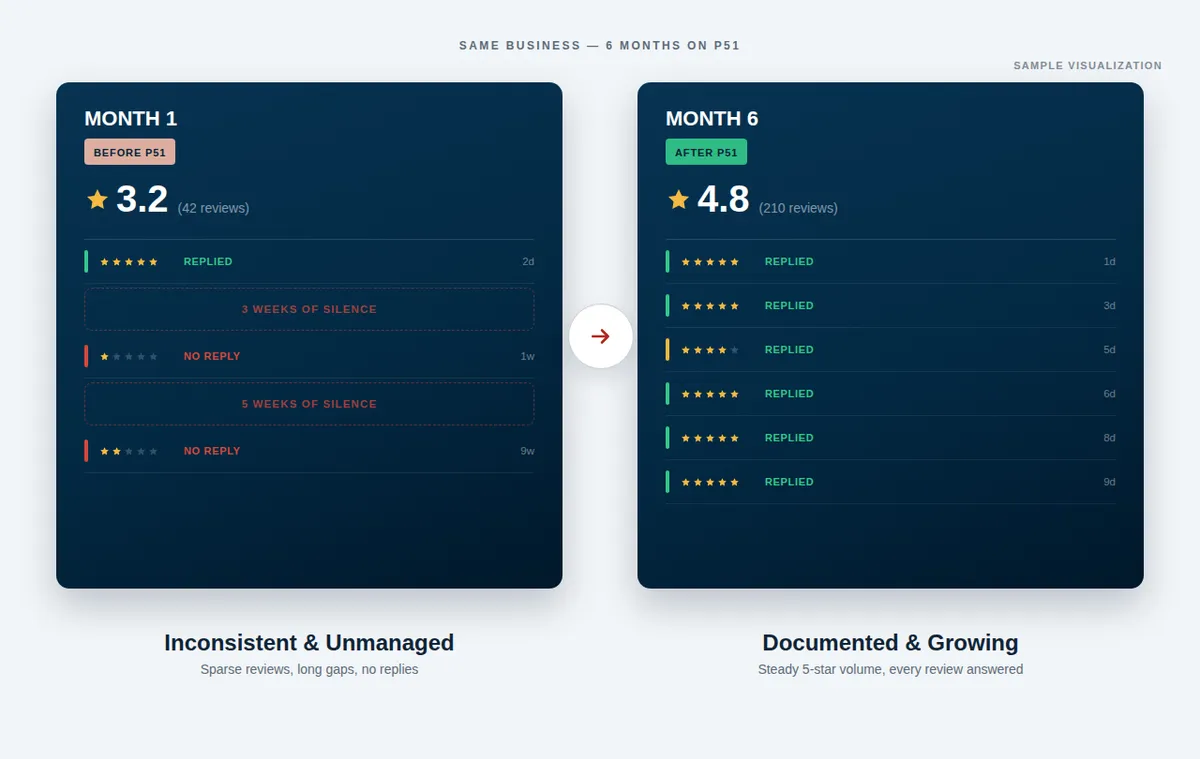
Nearly 1 in 3 Customers Won't Call You Under 4.5 Stars. Here's What That Costs.
A 4.3 used to be a good rating. For a lot of your customers, it isn't anymore.
BrightLocal's 2026 Local Consumer Review Survey asked 1,002 US adults how they choose local businesses. The headline number: 31% of consumers will only use a business rated 4.5 stars or higher. A year earlier, it was 17%.
That's nearly double in one year. And it means a business sitting at 4.3 or 4.4 is now being filtered out by almost a third of the people who find it, before anyone picks up the phone.
The bar moved, and most owners didn't notice
It's not just the 4.5 crowd. The same survey found:
41% of consumers always read reviews when choosing a business, up from 29% the year before.
68% will only use a business with 4 stars or more, up from 55%.
74% look for reviews from the last three months. Old reviews don't carry the weight they used to.
77% are less likely to use a business after reading negative reviews.
Put simply, more people are reading, they're reading more carefully, and they're holding you to a higher standard than they did a year ago. If your rating and review count haven't moved since 2024, you've fallen behind without doing anything wrong.
What it costs: run your own numbers
Here's a simple way to see what your rating is costing you. Use your own numbers. The example below is for illustration only.
Step 1. How many people see your Google Business Profile in a month? (Your profile's Performance tab shows this.)
Example: 1,000 people
Step 2. How many of them would normally call or request a quote?
Example: 5%, or 50 contacts
Step 3. If your rating is under 4.5, estimate the share you lose to the 4.5-only crowd.
Example: 31% of 50 = about 15 contacts a month that never happen
Step 4. Multiply by your close rate and average job value.
Example: 15 x 40% close rate x $600 average job = $3,600 a month, or about $43,000 a year
You'll never see those 15 people. They didn't call and hang up. They looked at your star rating, scrolled to the next business, and called them. That's what makes a weak rating so expensive: the loss is invisible.
Your numbers will be different. The point is that a few tenths of a star can add up to real money, and it's worth five minutes with a calculator.
Your rating now hurts you in two places
There's a second reason to care. Customers aren't only finding businesses on Google Maps anymore.
In the same BrightLocal survey, 45% of consumers used ChatGPT or another AI tool to get a local business recommendation, up from 6% the year before. AI tools pull heavily from reviews to decide who to recommend. A thin or mediocre review profile doesn't just lose you clicks on Google. It can keep you out of the AI answer entirely. (We'll cover how AI picks local businesses in an upcoming article.)
Reviews are also part of how Google ranks you on the map in the first place. A weak profile costs you twice: fewer people see you, and fewer of the people who see you call.
The fix: volume, recency, and responses
You can't buy your way to 4.5 stars, and you shouldn't try. Fake, purchased, and AI-written reviews are illegal under the FTC's Consumer Review Rule. What works is boring and consistent:
1. Volume: ask every customer, every time.
Most businesses with a low rating don't have unhappy customers. They have quiet happy customers. The people most motivated to leave a review on their own are the ones who are upset. Asking everyone evens that out. Ask right after the job is done, by text, with a direct link, and have the tech or owner do the asking. Ask every customer the same way, not just the ones you think are happy. Google's policies prohibit selectively asking only satisfied customers for reviews.
2. Recency: a steady flow beats a burst.
Since 74% of consumers look for reviews from the last three months, ten reviews spread across the quarter do more than ten reviews in one week followed by silence. Build the ask into your process so it happens on every job, not when you remember.
3. Responses: reply to all of them, in your own words.
80% of consumers are likely to use a business that responds to all of its reviews. But 50% are put off by generic, copy-paste replies. "Thanks for your business!" pasted under every review doesn't count. Mention the job, thank the person by name, and when a review is negative, own it calmly and say what you're doing about it. Your reply is for the next 100 people reading it, not just the reviewer.
Where do you actually stand?
Here's a quick check. Search your main service and look at the top 3 businesses that come up. Write down each one's star rating, review count, and the date of its most recent review. Then do the same for yours.
If you're behind on any of the three, you now know what it's costing you, and where to start.
Want us to run the comparison for you? We'll pull your rating, review count, and review recency next to your top 3 competitors, and show you what it will take to close the gap.
Get My Free Reputation Snapshot
Reviews are also one of the factors behind where you show up on Google Maps. If you haven't seen how your ranking changes across your service area, read Why Your Google Ranking Isn't One Number. It's Hundreds.


